
Medical AI
AI Embryo Assessment
Led AI diagnostic R&D for embryo assessment to MFDS (Korean FDA) clinical-trial approval, and rebuilt the product lifecycle to cut release cycles from ~2 months to 2–3 weeks.
Medical AI matters only when it clears regulatory review, earns clinicians' trust, and reaches patients worldwide. As a technologist turned business leader, I build the partnerships, channels, and teams that take it there.

Medical AI executive leading global business at Oncosoft, where I head the Global Business Division and drive expansion of AI radiation-oncology software across the US, Japan, Southeast Asia, and Latin America. I come from the technical side: I have built AI organizations from zero and taken products from prototype to regulated launch (FDA, CE, MFDS). At ROKIT Healthcare, I drove the commercial cycle from MVP to $1B+ in long-term contracts across the US, India, Turkey, the Middle East, and Latin America.
As Chief Business and Technology Officer, I lead Oncosoft's Global Business Division, taking an end-to-end AI platform for radiation oncology from regulatory clearance to clinical adoption across the US, Japan, Southeast Asia, and Latin America.

Radiation therapy planning still depends on manual contouring of organs and tumors: slow, variable between clinicians, and a bottleneck to treating more patients. For AI to fix that worldwide, it has to clear each market's regulators and reach clinics through channels they already trust.
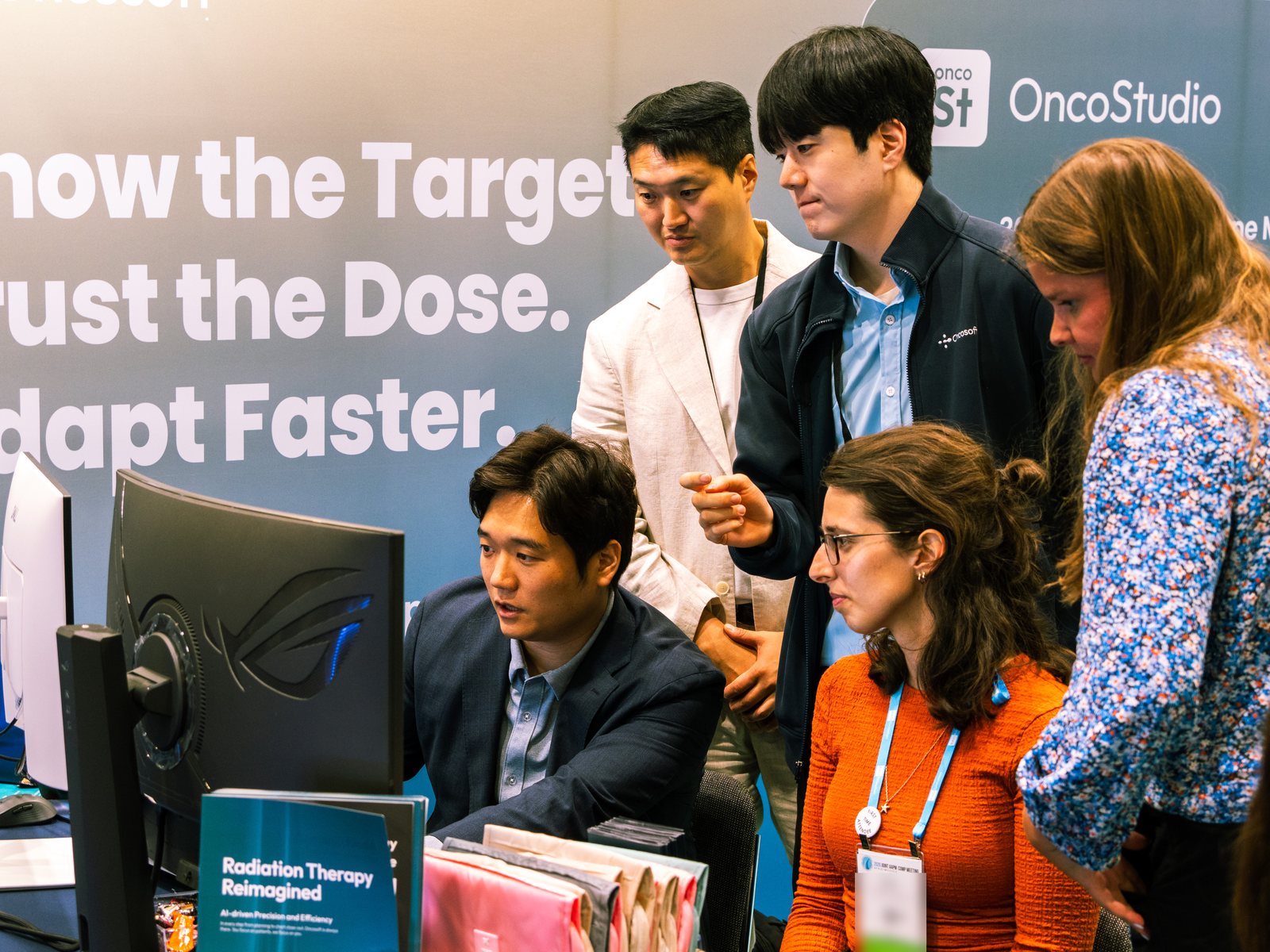
OncoStudio auto-contours organs-at-risk and tumors, major organs in about a minute, inside existing PACS, TPS, and EMR workflows. It anchors a platform with OncoFlow (workflow), OncoPlan (particle-therapy planning), and OncoAgent, a guideline-aware AI agent published at MICCAI 2026. My division turns that platform into market access: country-by-country regulatory entry, distribution and industry partnerships, government R&D programs and IP, and clinical AI deployment engineers who support adoption on site.
Cleared in six countries (Korea, US FDA 510(k), Japan, Singapore, Brazil, Indonesia), distributed in Chile through exclusive distributor OPUS, and used in 20+ hospitals in Korea. Mayo Clinic Florida is a customer under a 2025 solution supply agreement and a clinical validation partner; GenXRT is our first US commercial partner; Anzai Medical is the exclusive distributor in Japan. In particle therapy, OncoPlan was cleared by the MFDS in 2026 as the first carbon-ion treatment planning system developed by a Korean company, with Yonsei Cancer Center as technology transfer and joint R&D partner for carbon-ion planning and Samsung Medical Center as joint R&D partner for proton therapy validation.


An AI platform that turns a single tablet photo of a wound into a ready-to-print 3D patch model in seconds — then bio-prints it at the point of care to treat diabetic foot ulcers, deployed across the US, Asia, the Middle East, and Latin America.

Personalized regenerative patches require precise scanning, CAD modeling, and bioprinting — work that a surgical team anywhere in the world cannot realistically do at the point of care. To reach patients globally, the hard part had to disappear into software.
We built an AI platform (AiD Regen) that, from a single tablet RGB-D photo, segments the wound, reconstructs its 3D surface, and generates a ready-to-print 3D model in about 30 seconds. Production-grade MLOps on Google Cloud (Vertex AI, GKE) delivers identical quality at any clinical site — no on-site AI specialist required.
Founded and scaled the AI department from zero to 15, achieved both FDA and CE clearance, and drove the full commercial cycle from MVP to $1B+ in long-term contracts across the US, India, Turkey, the Middle East, and Latin America. Launched on AWS in 6 months, then migrated to Google Cloud in 3 — the work became a featured Google Cloud customer story.


Led AI diagnostic R&D for embryo assessment to MFDS (Korean FDA) clinical-trial approval, and rebuilt the product lifecycle to cut release cycles from ~2 months to 2–3 weeks.
A decade of human-computer interaction and augmented-reality research — IoT-device interaction in AR, 3D interaction techniques, and mobile sensing — published at ACM and IEEE venues including UIST and CHI. The technical foundation behind the products above.

Full list on Google Scholar →